
Major EU grant to explore early brain development
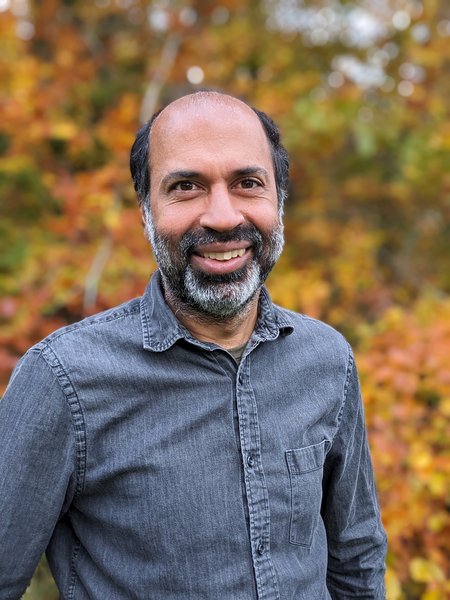
Professor Sarang Dalal, CFIN, Aarhus University, together with Ole Jensen at University of Oxford and Xavier De Tiège at Université libre de Bruxelles have been awarded an ERC Synergy Grant.
When does the human brain become ready for language and for understanding other people?
Researchers at the University of Oxford, Université libre de Bruxelles and Aarhus University have been awarded a DKK 101 million (€13.6 million) Synergy Grant from the European Research Council (ERC) to find out. Their six-year project, COG-MAT (Tracking Early Cognitive Maturation), starts before birth and follows how these uniquely human skills emerge in the brain, from the womb to school age.
Language and social understanding are central to our personal, social and cultural lives. Yet the brain lays their foundations long before a child's first word, out of reach of behavioural tests. The team's central idea is that the young brain is slow: its rhythms are slower and its responses arrive later than an adult's. As nerve fibres mature and experience builds up, processing speeds up – and that may be what lets language and social cognition take hold.
Starting in the womb
The project uses OPM-MEG, a new generation of silent, lightweight sensors that pick up the brain's tiny magnetic fields. Teams in Aarhus and Brussels have already used it to record responses to sound and light from unborn babies. Placed on the mother's abdomen in weeks 32–36 of pregnancy and guided by ultrasound, the sensors will now show whether the unborn child already follows the rhythm of speech and picks up patterns in sounds – early building blocks of language.
Five stages, three countries
The team will make around 750 recordings, 150 at each of five stages:
- Before birth (32–36 weeks): responses to sound and light, speech tracking, pattern detection.
- 3–4 months: tuning to speech, faces and gaze, and to the caregiver's face.
- 30 months: from single words to sentences; first signs of empathy and helping.
- 4 years: complex sentences, and the brain networks behind empathy.
- 8 years: reading, and how children make sense of helpful behaviour.
Children measured before birth or as babies return at ages two and four, testing whether early brain signals predict later language and social abilities. Testing in English, French, and Danish checks that milestones hold across languages and cultures.
From basic science to every child
The result will be the first comprehensive map of how the brain matures for language and social cognition. It will also show when development takes a different path, as in dyslexia and autism, studied at age eight. All data, methods, and code will be shared openly.
"This is basic science at its core," says project lead Professor Ole Jensen, University of Oxford. "We want to know when the human brain becomes ready for the skills that define us: understanding speech and understanding each other. Wearable sensors finally let us follow that process continuously, from before birth to the classroom."
"Now the size of Lego bricks, this new generation of quantum sensors makes this research possible. For the first time, we can use the exact same technology to measure the first sparks of brain activity before birth and how they evolve through infancy and early childhood," says Professor Sarang Dalal, Aarhus University.
Ole Jensen brings expertise in cognitive neuroscience; Sarang Dalal (Aarhus University) leads the sensor technology and analysis; and Xavier De Tiège (Université libre de Bruxelles) contributes developmental and clinical neuroimaging. Together they aim to make methods and appropriately protected research data available to the wider scientific community.
Aarhus University will receive approximately DKK 36 million of the total ERC Synergy Grant funding for the project, known as COG-MAT.

OPM-MEG recordings across early development: fetal (left), infant (centre) and child (right).
Images: COG-MAT proposal, Figure 1 (Brussels team).
COG-MAT project
COG-MAT: six years, total budget €13,573,885
(Oxford €4,634,455; ULB €4,060,605; Aarhus €4,878,825).
Principal investigators:
- Professor Ole Jensen (corresponding PI)
Oxford Centre for Integrative Neuroimaging, Oxford Centre for Human Brain Activity, Department of Psychiatry and Department of Experimental Psychology
University of Oxford, UK - Professor Xavier De Tiège
ULB Neuroscience Institute and Department of Translational Neuroimaging, Hôpital Universitaire de Bruxelles, Hôpital Erasme
Université Libre de Bruxelles, Brussels, Belgium - Professor Sarang Dalal
Center of Functionally Integrative Neuroscience (CFIN), Department of Clinical Medicine and
Department of Electrical & Computer Engineering
Aarhus University, Denmark
Contact
Professor Sarang Dalal
Aarhus University, Department of Clinical Medicine – Center of Functionally Integrative Neuroscience (CFIN) and
Aarhus University, Department of Electrical and Computer Engineering
Email: sarang@cfin.au.dk