
New paper from Center for Music in the Brain in 'Advanced Science'
By combining MEG, MRI and advanced brain network analyses, MIB researchers Mathias Houe Andersen, Leonardo Bonetti and colleagues reveal how aging differentially affects sensory and cognitive predictive processing. Their findings challenge the conventional view that the brain's ability to detect unexpected events uniformly declines with age.
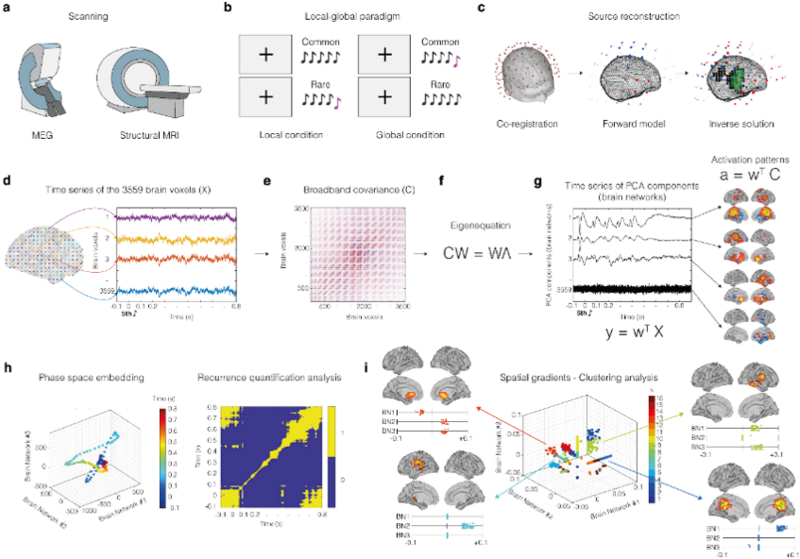
Our brain continuously generates predictions about the surrounding environment and detects unexpected events when sensory information violates these expectations. Although aging is commonly associated with a decline in these predictive processes, the underlying changes in large-scale brain networks remain poorly understood.
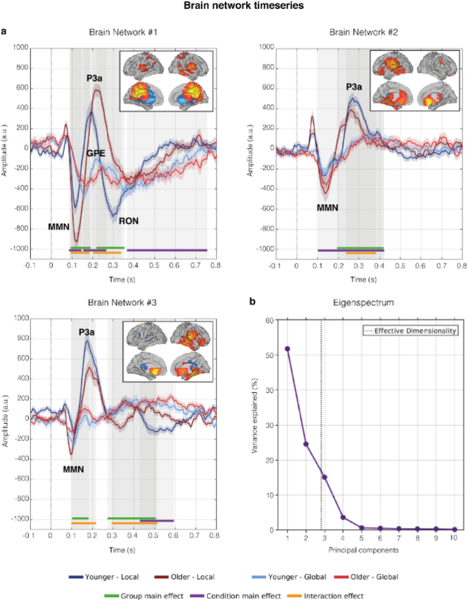
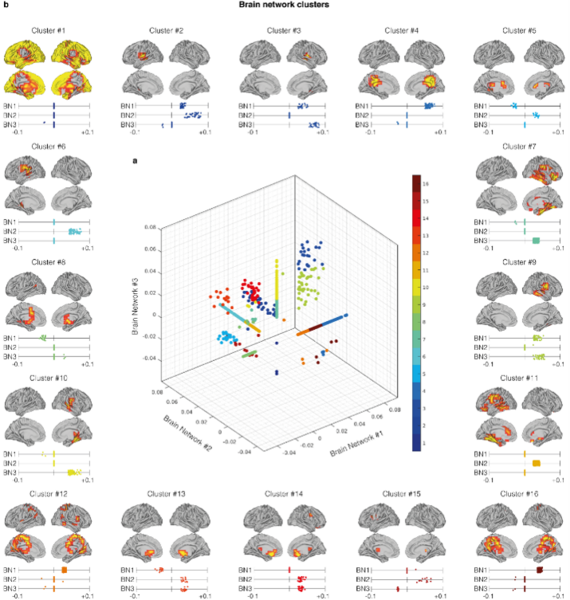
Using magnetoencephalography (MEG) and MRI, we investigated brain activity in 77 participants (37 younger and 40 older adults) while they listened to auditory sequences containing unexpected changes in individual tones or broader sound patterns. By applying an advanced brain network analysis framework called BROAD-NESS, we identified three simultaneously operating brain networks connecting auditory cortices with cingulate, temporal, and frontal regions.
Our findings demonstrate that aging does not uniformly weaken predictive processing. Instead, older adults exhibited enhanced early neural responses to unexpected individual tones within a network connecting auditory cortices with medial and posterior cingulate regions. Conversely, later neural responses associated with cognitively demanding processes, including attentional reorientation and the detection of unexpected sound patterns, were attenuated in older adults.
Furthermore, by examining the evolving dynamics of these brain networks, we found that unexpected individual tones elicited more recurrent and predictable patterns of neural activity, whereas violations of broader auditory patterns engaged more distributed and divergent network dynamics. Importantly, these dynamical distinctions were preserved across age groups.
This study advances our understanding of predictive processing by demonstrating that healthy aging selectively alters the engagement of sensory and cognitive brain networks rather than producing a uniform decline. The findings further highlight the importance of investigating large-scale brain network dynamics to better understand how the aging brain adapts to unexpected information.
TITLE
Brain Network Dynamics of Local and Global Predictive Processing in Aging
AUTHORS
M. H. Andersen, G. Fernández-Rubio, D. R. Quiroga-Martinez, M. Rosso, M. Klarlund, K. M. Larsen, H. R. Siebner, M. L. Kringelbach, P. Vuust & L. Bonetti
READ THE PAPER HERE
Brain Network Dynamics of Local and Global Predictive Processing in Aging | Advanced Science
CONTACT
Mathias Houe Andersen – mathiasha@drcmr.dk
Leonardo Bonetti – leonardo.bonetti@psych.ox.ac.uk