MÉLANIE STRAUSS
Title: When the Sleeping Brain Keeps Listening: Predictive Coding of Sound Across Sleep
Abstract: When exposed to an auditory sequence, the brain functions as a predictive-coding device, extracting regularities in the transition probabilities between sounds and detecting unexpected deviations from these patterns. But does such prediction require conscious vigilance, or can it continue to unfold automatically during sleep?
In this presentation, we will explore how the mismatch negativity (MMN) and P300 components of the auditory event-related potential—reflecting two hierarchical stages of auditory novelty detection—are differentially affected by sleep. We will also describe the descent into sleep and examine how predictive coding capabilities evolve with the loss of conscious access to auditory stimuli.
Bio: Dr. Mélanie Strauss is a neurologist and sleep researcher at the Université libre de Bruxelles (ULB), Belgium, where she heads the multidisciplinary Sleep Unit and the Scientific Program of the Integrated Memory Clinic at Hôpital Universitaire de Bruxelles. She is also Professor of Neurology and Sleep Medicine and FNRS Researcher at the Experimental Neurology Lab (ULB).
Her research focuses on the neural dynamics of sleep, vigilance, and cognition, combining EEG, MEG, and multimodal neuroimaging to explore sleep onset, memory consolidation, and early markers of neurodegenerative disease. Dr. Strauss also serves on the scientific board of the French Sleep Research Society (SFRMS) and the advisory board of the Belgian Association for Sleep Research and Sleep Medicine (BASS).

MARCUS PEARCE
Title: Learning to listen, Listening to learn: Modelling musical perception and pleasure
Abstract: Music is universal across human societies and, alongside speech, forms a central cultural component of auditory experience. And yet it is only recently that we have begun to understand the process of learning across the lifespan that enables enculturated listeners to perceive and appreciate the music of their cultures. This understanding depends on computational modelling of the psychological mechanisms involved. Of particular interest is the mechanism of expectation: an obligatory process in which the brain generates predictions for what will happen next based on learning of patterns in previous experience. In musical listening, expectations are generated for both the pitch and timing of musical events as well as more abstract musical structure such as harmonic movement. These expectations reflect both the lifetime musical experience of the listener held in long-term memory as well as local learning of repeated patterns within the current listening episode, held in short-term memory. Expectations also influence perception of musical complexity with more unpredictable music being perceived as more complex than more predictable music. These effects of expectation on perceived complexity in turn influence experience of affect and pleasure when listening to music. Greater unpredictability is associated with heightened arousal assessed both subjectively and physiologically. Pleasure meanwhile shows an inverted-U shaped relationship with unpredictability such that intermediate levels of unpredictability evoke greatest pleasure. This can be related to an underlying mechanism of learning progress in which our brains take pleasure in learning the structure of a piece of music such that simple, predictable music fails to support sustained learning while complex, unpredictable music fails to support a sufficiently high learning rate. The optimal levels of predictability will depend both on the individual and the context.
Bio: Marcus Pearce is Reader in Cognitive Science at Queen Mary University of London and Honorary Professor of Neuroscience at Aarhus University, Denmark. He has published more than 80 journal articles on auditory perception and cognition as well as the entry on Music Perception in the Oxford Research Encyclopedia of Psychology and the research monograph Learning to listen, listening to learn (Oxford University Press, 2025). He has given presentations at the Wellcome Collection and Royal Institution, run a Live Science residency at the Science Museum, delivered the IEE Faraday Lecture, and collaborated with the London Sinfonietta to produce a free iOS app for developing rhythm skills described by the New York Times as "maddeningly addictive". He was educated in Experimental Psychology at the University of Oxford and Artificial Intelligence at the University of Edinburgh.
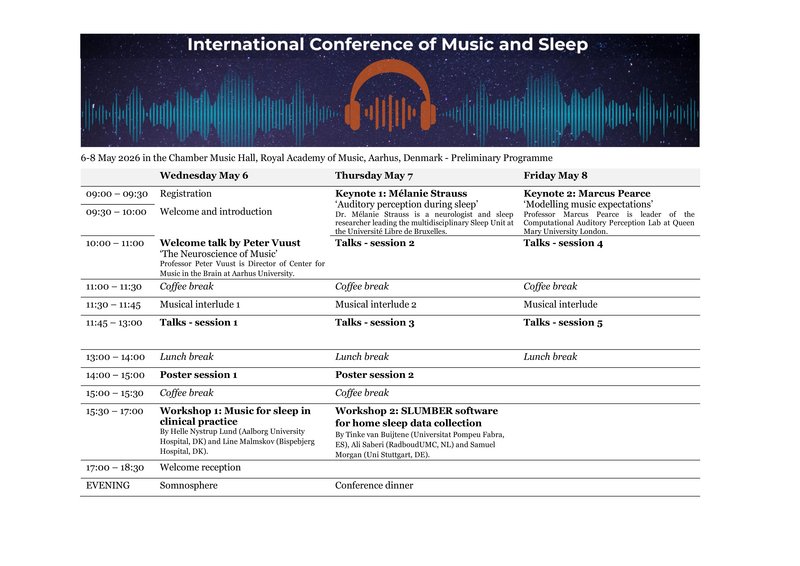
Welcome lecture on Music Neuroscience by Professor Peter Vuust, Center for Music in the Brain, Aarhus University.

Workshop 1: The use of music for sleep in clinical practice
Wednesday May 6, 15:30-17:00.
More information coming soon.
Workshop 2: SLUMBER: software for home EEG sleep recordings
Thursday May 7, 15:30-17:00.
More information coming soon.
An immersive, audio-visual expression of the sleep experience.
More information coming soon.
Tuesday May 5, 19:30
Vocal Soirée in the Chamber Music Hall.
Free entrance.
Read more here: https://musikkons.dk/en/events/sangsoire-21-2/
Wednesday May 6, 17:00
Welcome reception at the Royal Academy of Music (included in Conference fee).
Thursday May 7
Conference dinner (included in the Conference fee).
Friday May 8
Free entrance at AROS - the iconic art museum of Aarhus.
Read more about the museum and the exhibitions here: https://www.aros.dk/en/.
The museum is right next door to the Chamber Music Hall.