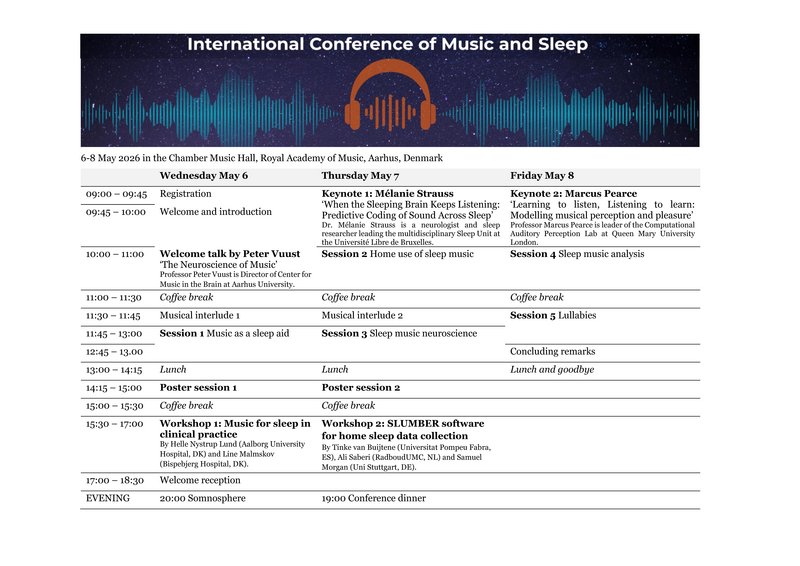
| TIME | ACTIVITY | VENUE |
| 09.00 – 09.45 | Morning coffee and registration | Foyer outside the Chamber music hall |
| 09.45 – 10.00 | Opening remarks | Chamber music hall |
| 10.00 – 11.00 | Welcome lecture Professor Peter Vuust, Center for Music in the Brain, AU The neuroscience of music | Chamber music hall |
| 11.00 – 11.30 | Coffee break | Foyer outside the Chamber music hall |
| 11.30 – 11.45 | Musical interlude 1 Bloom (Sarah Solow, vocals, & Tobias Møller, guitar) | Chamber music hall |
| 11.45 – 13.00 | Talk session 1: Music as a sleep aid
| Chamber music hall |
| 13.00 – 14.15 | Lunch | Royal Academy of Music 4th floor |
| 14.15 – 15.00 | Poster session 1 Mixed topic poster session | Chamber music hall |
| 15.00 – 15.30 | Coffee break | Foyer outside the Chamber music hall |
| 15.30 – 17.00 | Workshop 1: Music for sleep in hospitals
| Chamber music hall |
| 17.00 – 18.30 | Welcome reception | Royal Academy of Music 4th floor & roof terrasse |
| 20.00 – 21.30 | Somnosphere Audiovisual installation created by the Lullabyte Doctoral Candidates. | Chamber music hall |
| TIME | ACTIVITY | VENUE |
| 09.00 – 10.00 | Keynote lecture 1 Professor Mélanie Strauss, Université libre de Bruxelles (ULB), Belgium When the Sleeping Brain Keeps Listening: Predictive Coding of Sound Across Sleep | Chamber music hall |
| 10.00 – 11.00 | Talk session 2: Home use of sleep music
| Chamber music hall |
| 11.00 – 11.30 | Coffee break | Foyer outside the Chamber music hall |
| 11.30 – 11.45 | Musical interlude 2 Rebecca Vats Jonsson, classical guitar | Chamber music hall |
| 11.45 – 13.00 | Talk session 3: Sleep music neuroscience
| Chamber music hall |
| 13.00 – 14.15 | Lunch | Royal Academy of Music 4th floor |
| 14.15 – 15.00 | Poster session 2 Mixed topic poster session | Chamber music hall |
| 15.00 – 15.30 | Coffee break | Foyer outside the Chamber music hall |
| 15.30 – 17.00 | Workshop 2: SLUMBER: A Framework for Home-Based Sleep Experiments Offering Dynamic Delivery of Auditory Stimuli
| Chamber music hall |
| 19.00 – 22.00 | Conference dinner | Malt Ceresbyen 68c 8000 Aarhus C |
| TIME | ACTIVITY | VENUE |
| 09.00 – 10.00 | Keynote lecture 2 Professor Marcus Pierce, Queen Mary University of London, UK Learning to listen, Listening to learn: Modelling musical perception and pleasure | Chamber music hall |
| 10.00 – 11.00 | Talk Session 4: Sleep music analysis
| Chamber music hall |
| 11.00 – 11.30 | Coffee break | Foyer outside the Chamber music hall |
| 11.30 – 12.45 | Talk Session 5: Lullabies
| Chamber music hall |
| 12.45-13.00 | Concluding remarks | Chamber music hall |
| 13.00 – 14.00 | Lunch and goodbye | Royal Academy of Music 4th floor |
The Book of Abstracts can be downloaded here.

MÉLANIE STRAUSS
Title: When the Sleeping Brain Keeps Listening: Predictive Coding of Sound Across Sleep
Abstract: When exposed to an auditory sequence, the brain functions as a predictive-coding device, extracting regularities in the transition probabilities between sounds and detecting unexpected deviations from these patterns. But does such prediction require conscious vigilance, or can it continue to unfold automatically during sleep?
In this presentation, we will explore how the mismatch negativity (MMN) and P300 components of the auditory event-related potential—reflecting two hierarchical stages of auditory novelty detection—are differentially affected by sleep. We will also describe the descent into sleep and examine how predictive coding capabilities evolve with the loss of conscious access to auditory stimuli.
Bio: Dr. Mélanie Strauss is a neurologist and sleep researcher at the Université libre de Bruxelles (ULB), Belgium, where she heads the multidisciplinary Sleep Unit and the Scientific Program of the Integrated Memory Clinic at Hôpital Universitaire de Bruxelles. She is also Professor of Neurology and Sleep Medicine and FNRS Researcher at the Experimental Neurology Lab (ULB).
Her research focuses on the neural dynamics of sleep, vigilance, and cognition, combining EEG, MEG, and multimodal neuroimaging to explore sleep onset, memory consolidation, and early markers of neurodegenerative disease. Dr. Strauss also serves on the scientific board of the French Sleep Research Society (SFRMS) and the advisory board of the Belgian Association for Sleep Research and Sleep Medicine (BASS).

MARCUS PEARCE
Title: Learning to listen, Listening to learn: Modelling musical perception and pleasure
Abstract: Music is universal across human societies and, alongside speech, forms a central cultural component of auditory experience. And yet it is only recently that we have begun to understand the process of learning across the lifespan that enables enculturated listeners to perceive and appreciate the music of their cultures. This understanding depends on computational modelling of the psychological mechanisms involved. Of particular interest is the mechanism of expectation: an obligatory process in which the brain generates predictions for what will happen next based on learning of patterns in previous experience. In musical listening, expectations are generated for both the pitch and timing of musical events as well as more abstract musical structure such as harmonic movement. These expectations reflect both the lifetime musical experience of the listener held in long-term memory as well as local learning of repeated patterns within the current listening episode, held in short-term memory. Expectations also influence perception of musical complexity with more unpredictable music being perceived as more complex than more predictable music. These effects of expectation on perceived complexity in turn influence experience of affect and pleasure when listening to music. Greater unpredictability is associated with heightened arousal assessed both subjectively and physiologically. Pleasure meanwhile shows an inverted-U shaped relationship with unpredictability such that intermediate levels of unpredictability evoke greatest pleasure. This can be related to an underlying mechanism of learning progress in which our brains take pleasure in learning the structure of a piece of music such that simple, predictable music fails to support sustained learning while complex, unpredictable music fails to support a sufficiently high learning rate. The optimal levels of predictability will depend both on the individual and the context.
Bio: Marcus Pearce is Reader in Cognitive Science at Queen Mary University of London and Honorary Professor of Neuroscience at Aarhus University, Denmark. He has published more than 80 journal articles on auditory perception and cognition as well as the entry on Music Perception in the Oxford Research Encyclopedia of Psychology and the research monograph Learning to listen, listening to learn (Oxford University Press, 2025). He has given presentations at the Wellcome Collection and Royal Institution, run a Live Science residency at the Science Museum, delivered the IEE Faraday Lecture, and collaborated with the London Sinfonietta to produce a free iOS app for developing rhythm skills described by the New York Times as "maddeningly addictive". He was educated in Experimental Psychology at the University of Oxford and Artificial Intelligence at the University of Edinburgh.
Welcome lecture on Music Neuroscience by Professor Peter Vuust, Center for Music in the Brain, Aarhus University.

Workshop 1: Music for Sleep in Hospitals
Wednesday May 6, 15:30-17:00.
Helle Nystrup Lund, PhD, Music therapist, Aalborg University Hospital, Denmark
Line Malmskov, MA, Music therapist, Bispebjerg Hospital, Denmark
Abstract can be downloaded here
Workshop 2: SLUMBER: A Framework for Home-Based Sleep Experiments Offering Dynamic Delivery of Auditory Stimuli
Thursday May 7, 15:30-17:00.
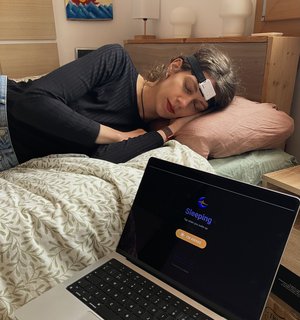
Tinke van Buijtene, Music Technology Group (MTG), Universitat Pompeu Fabra, Barcelona, Spain
Ali Saberi, Donders Institute for Brain, Cognition and Behaviour; Radboud University Medical Center, Nijmegen, The Netherlands.
Samuel Morgan, Institute for Parallel and Distributed Systems (IPVS), University of Stuttgart, Stuttgart, Germany
Wednesday May 6, 11.30
In a world full of noise, BLOOM creates experimental and improvisation-driven soundscapes, where the music functions as a guide that accompanies the listener without ever imposing itself.
The sounds, shaped by both organic and electronic elements, unfold and form living spaces that can soothe, inspire, or allow the mind to drift. The improvisation within the project creates a dynamic interplay, where sender and receiver influence one another, and where together we shape the space we inhabit.
BLOOM consists of:
Sarah Sejer Solow – singer and songwriter, educated at the Royal Academy of Music.
Tobias Skriver Møller – guitarist and producer, educated at the Royal Academy of Music.
Website: https://bit.ly/bloom-lyd
Thursday May 7, 11.30
Rebecca Vats Jonsson is a classical guitarist from Sweden. She is currently enrolled in the soloist programme at the Royal Academy of Music in Aarhus, where she studies under Professor Frederik Munk Larsen.
Throughout her career as a guitarist, she has had the opportunity to perform in a wide range of settings, both as a soloist and as a chamber musician across Europe and the United States. She has also been awarded first prizes in competitions in both Sweden and Germany.
Over the past seven years, she has participated in various projects exploring the intersection of music and health, working in hospitals and performance venues across Denmark. During her bachelor’s and master’s studies, she also developed two pilot research projects within the field of music and health, investigating the impact of music on pain and well-being.
In 2022, she was among the first musicians to be employed as a healthcare musician at Aarhus University Hospital. Today, she performs weekly intimate concerts, primarily in intensive care units across hospitals in the Central Denmark Region—a passion she is deeply committed to.
Website: www.rebeccavatsjonsson.com
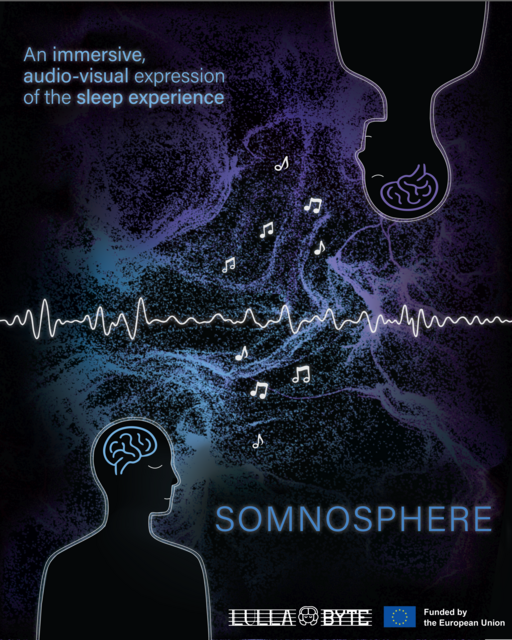
Somnosphere is an immersive installation that makes the deeply personal experience of sleep accessible through a dynamic audiovisual environment. While sleep is typically a solitary and incommunicable state, Somnosphere asks a provocative question: What does it mean to be together while unconscious?
During sleep, we disconnect from the waking world, yet our brains remain responsive to sound. Building on this, Somnosphere creates a “closed loop” between two individuals in different locations, facilitating a sonic exchange in which each sleeper influences the other. By listening to real-time musical representations of each other’s sleep throughout the night, an intimate exchange is formed between two subconscious minds.
This exchange unfolds again in real-time within the installation space, based on previously-recorded data. Visitors are invited to step inside this environment, observing the progression of the two sleepers throughout the night. They hear generative music created within a live-coding environment, which is adapted from EEG and other physiological data recorded from the sleepers. This sonic representation is mirrored by algorithmically-generated visuals, which respond dynamically to the same patterns of shifting sleep cycles.
Rather than presenting sleep as static data, Somnosphere expresses it as a living experience that evolves over time. This work positions sleep not as an absent state, but as a medium of connection in which two distant bodies communicate and co-exist within a common nocturnal sonic world.
This project is developed by an interdisciplinary team of doctoral candidates within Lullabyte, an EU-funded research network integrating the fields of neuroscience, musicology, and data science.
Tuesday May 5, 19:30
Vocal Soirée in the Chamber Music Hall.
Free entrance.
Read more here: https://musikkons.dk/en/events/sangsoire-21-2/
Wednesday May 6, 17:00
Welcome reception at the Royal Academy of Music (included in Conference fee).
Wednesday May 6, 20:00
Somnosphere: An immersive audio-visual expression of the sleep experience.
Free entrance.
Thursday May 7, 19:00
Conference dinner (included in the Conference fee).
Malt
Ceresbyen 68c
8000 Aarhus C
Friday May 8
Free entrance at AROS - the iconic art museum of Aarhus. Ticket available at the conference registration desk.
Read more about the museum and the exhibitions here: https://www.aros.dk/en/.
The museum is right next door to the Chamber Music Hall.